# Where do I actually blunder?
My last hundred online chess games: 49 wins, one draw, 50 losses. I know I blunder. What I could not say is *which* blunders, how often, or whether I am getting any better.
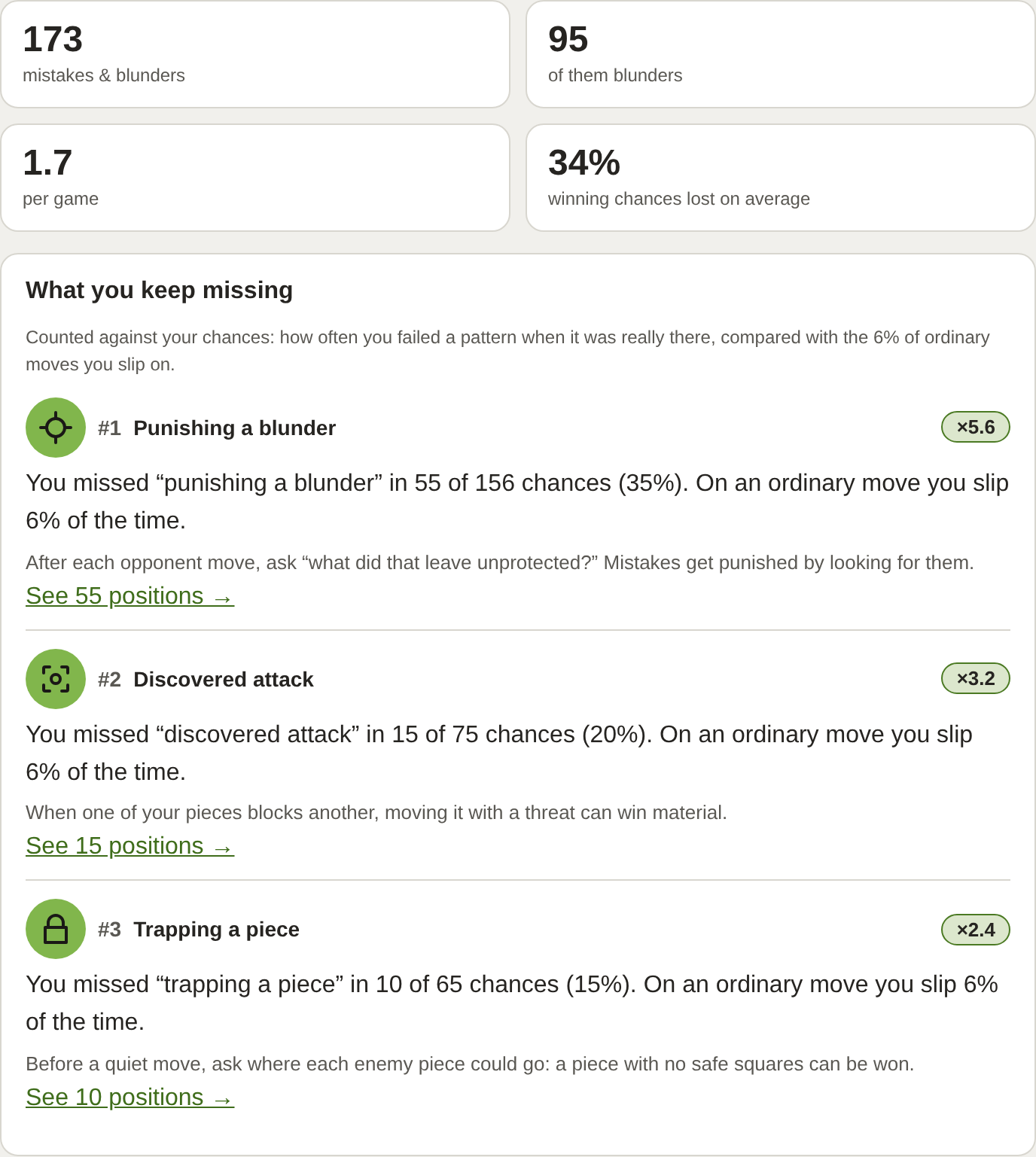
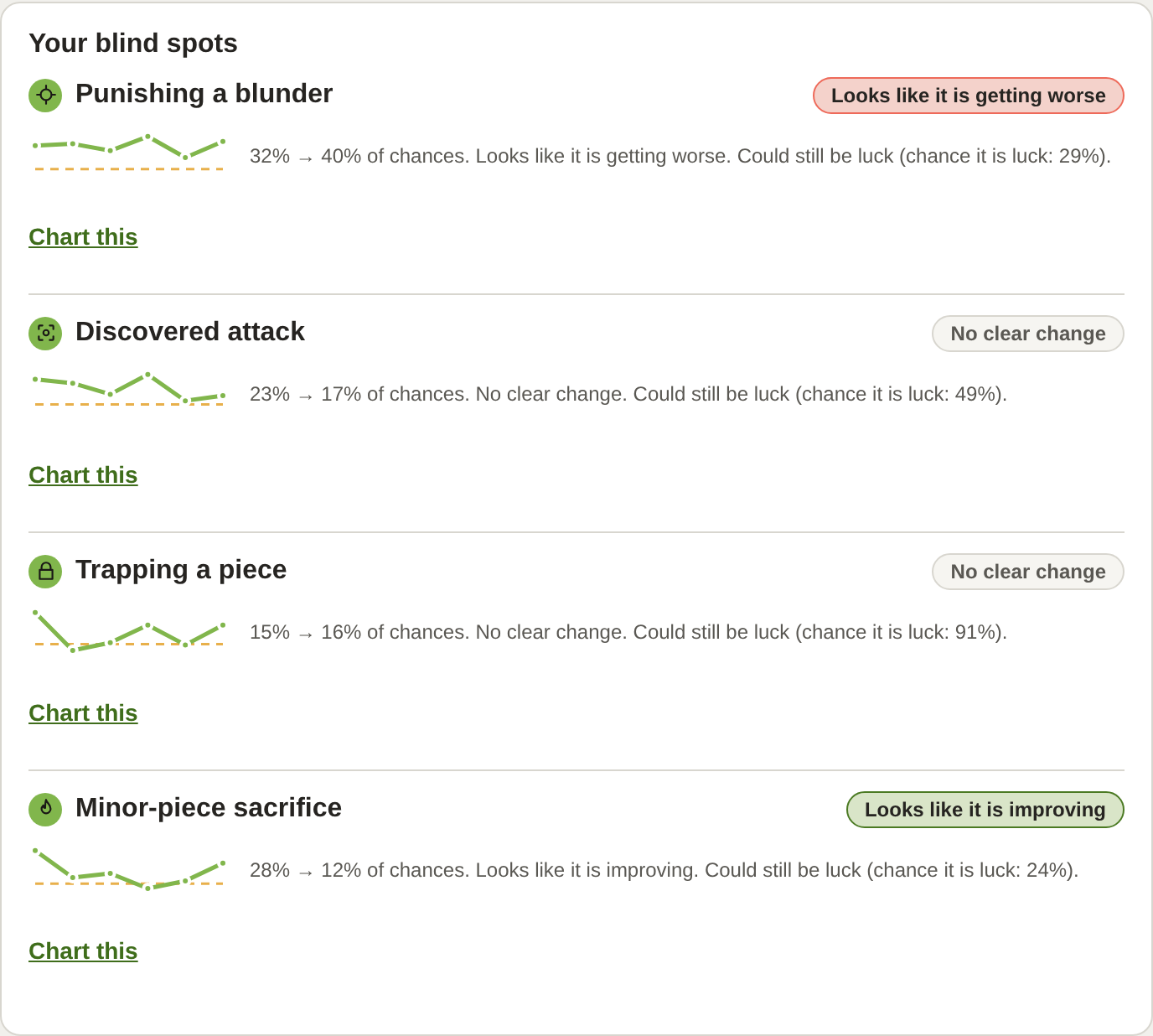
The answer, from my last hundred games (the top three of six). The number on the right of each row says how many times more often than usual I fail that pattern. The rest of this post is about how to get to a list like this one honestly.
**The problem.** A chess site shows me the best move in one game. A coach would see the pattern across all of them. I wanted a tool that reads every game I play, finds the moments where I gave the game away, and tells me what keeps happening.
**This post** is about that tool, called Blindspot, and about the order I built it in. First came flashcards, then a way to find my own mistakes, then a ranking that turned out to be wrong, then a fixed one. The fixed one says something I did not expect. I am not bad at spotting danger. I am bad at taking what my opponent hands me.
## It started with flashcards
I already use Anki, a flashcard program that shows a card again just before you would forget it. Chess puzzles never stick for me. I solve one, feel clever, and never see it again. So the first project was an add-on, which I called Knightly, that puts a real board on the card. You move the pieces, the card tells you whether you were right, and Anki decides when you see it again.
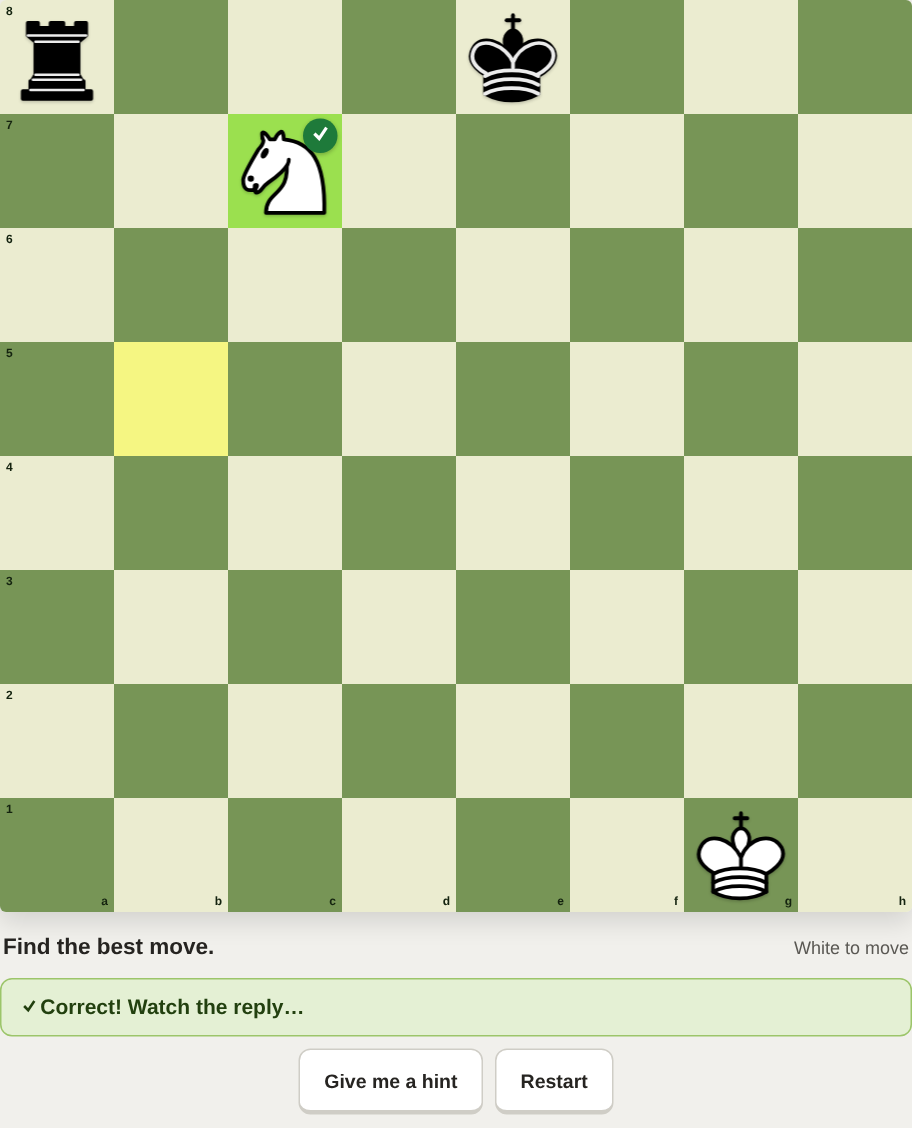
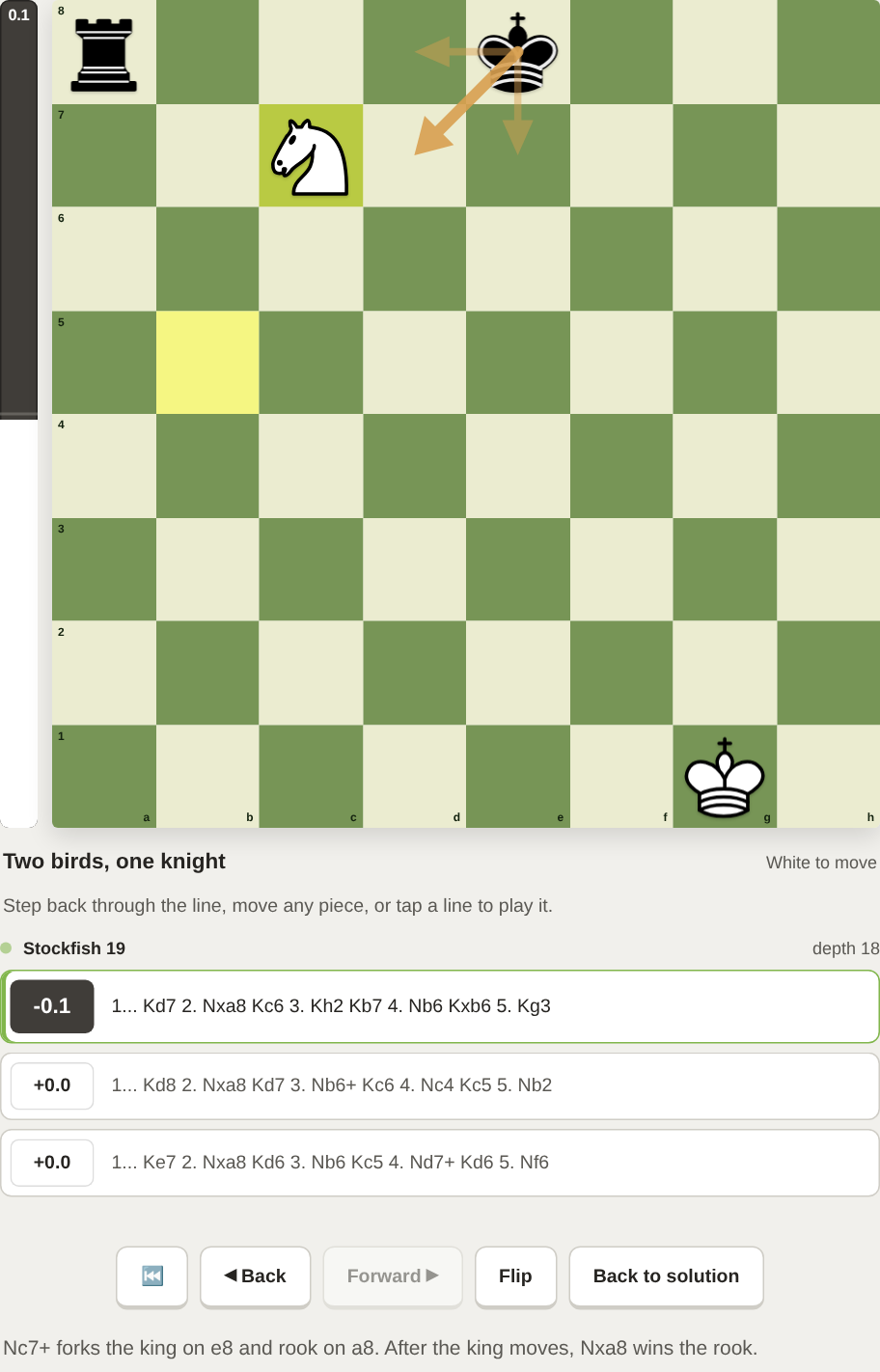
A card. Drag or tap the piece. A right move turns the square green for a second, a wrong one red, and then the card moves on or lets me try again.
Small details mattered more than I expected. The card waits a second after my move so I can read the verdict. A wrong move stays on the board for that second before it snaps back, so I see what I did. And when I am right, the card goes straight to the answer, with no extra button to press.
One rule came from being annoyed. Sometimes I found a different move that was just as good, and the card marked me wrong. Now the card asks Stockfish, the strongest chess program there is, and if it rates my move about as good as the stored one, I am right.
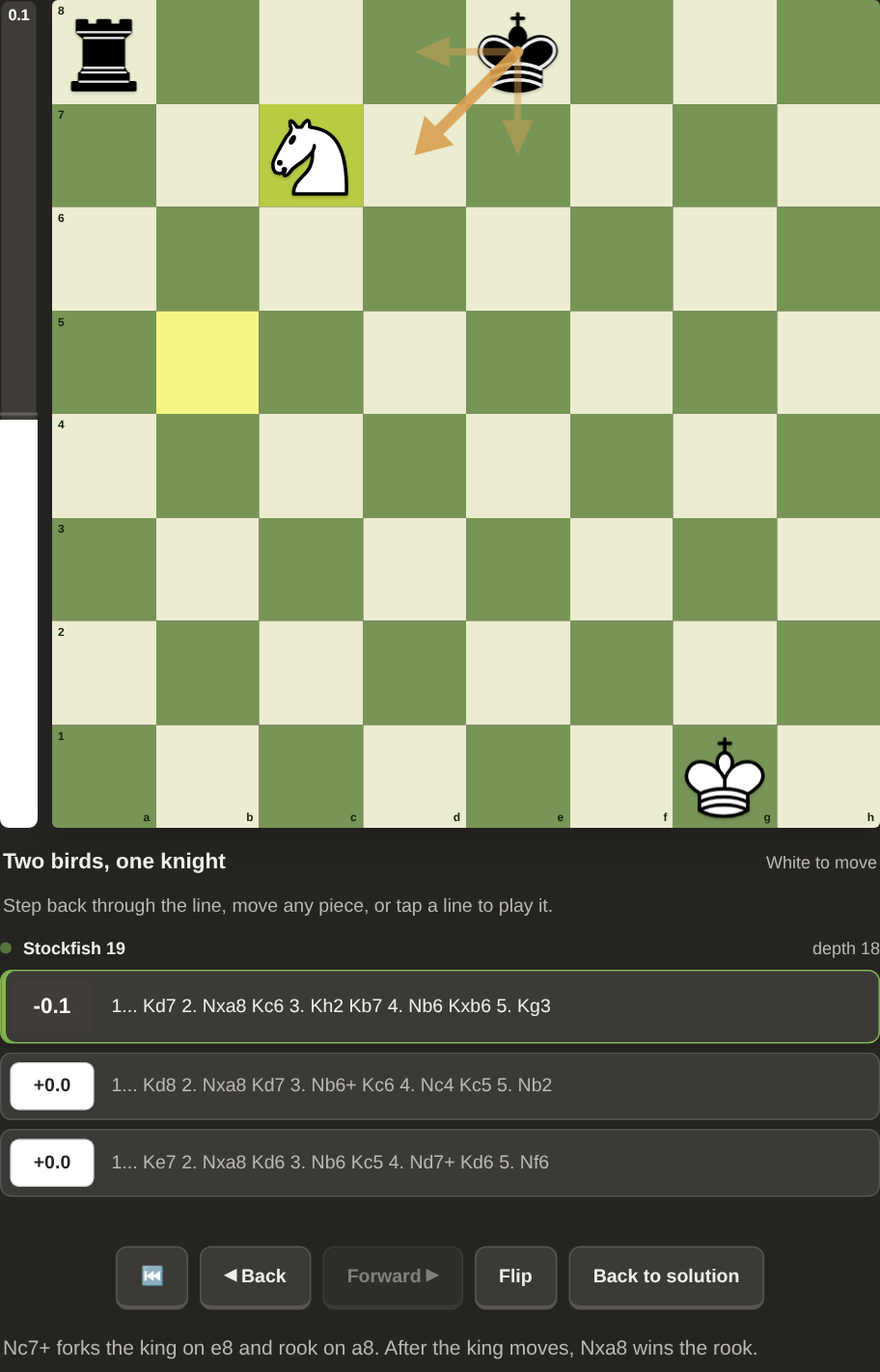
The answer side, with Stockfish one tap away. The tall bar shows who is better, the three lines are its best ideas, and I can step back and forward through the moves.
## The cards were someone else's positions
The cards worked, but they were puzzles from strangers. What I needed to learn were my own positions: the ones where I actually lost. That changed the question from "how do I get better at tactics?" to "where do I lose?"
So I dropped the add-on idea and built an app that starts from a chess.com username.
## Blindspot reads my games and sorts my mistakes
I type a username. The app fetches my public games and has Stockfish look at every move. A move counts as a mistake when it gives away a large share of my winning chances compared with the engine's choice.
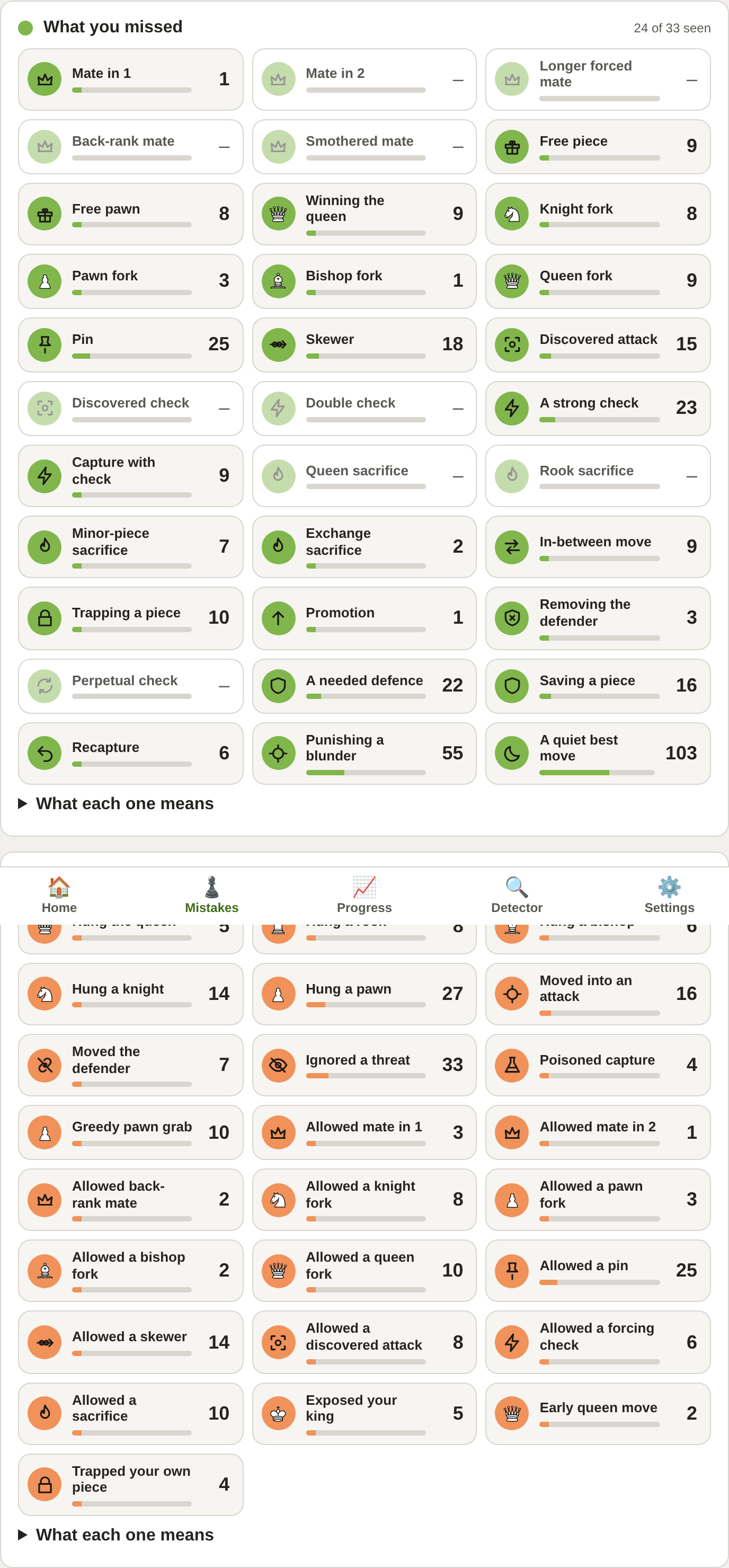
Then it labels each mistake. There are about a hundred labels, in three families. **What I missed**: a fork, a free piece, a mate. **What my move allowed**: leaving a piece hanging, walking into a pin. **The circumstances**: opening or endgame, how much time I had, whether I was winning. Each label has a plain name, a colour and an icon, so a page of mistakes can be scanned instead of read.
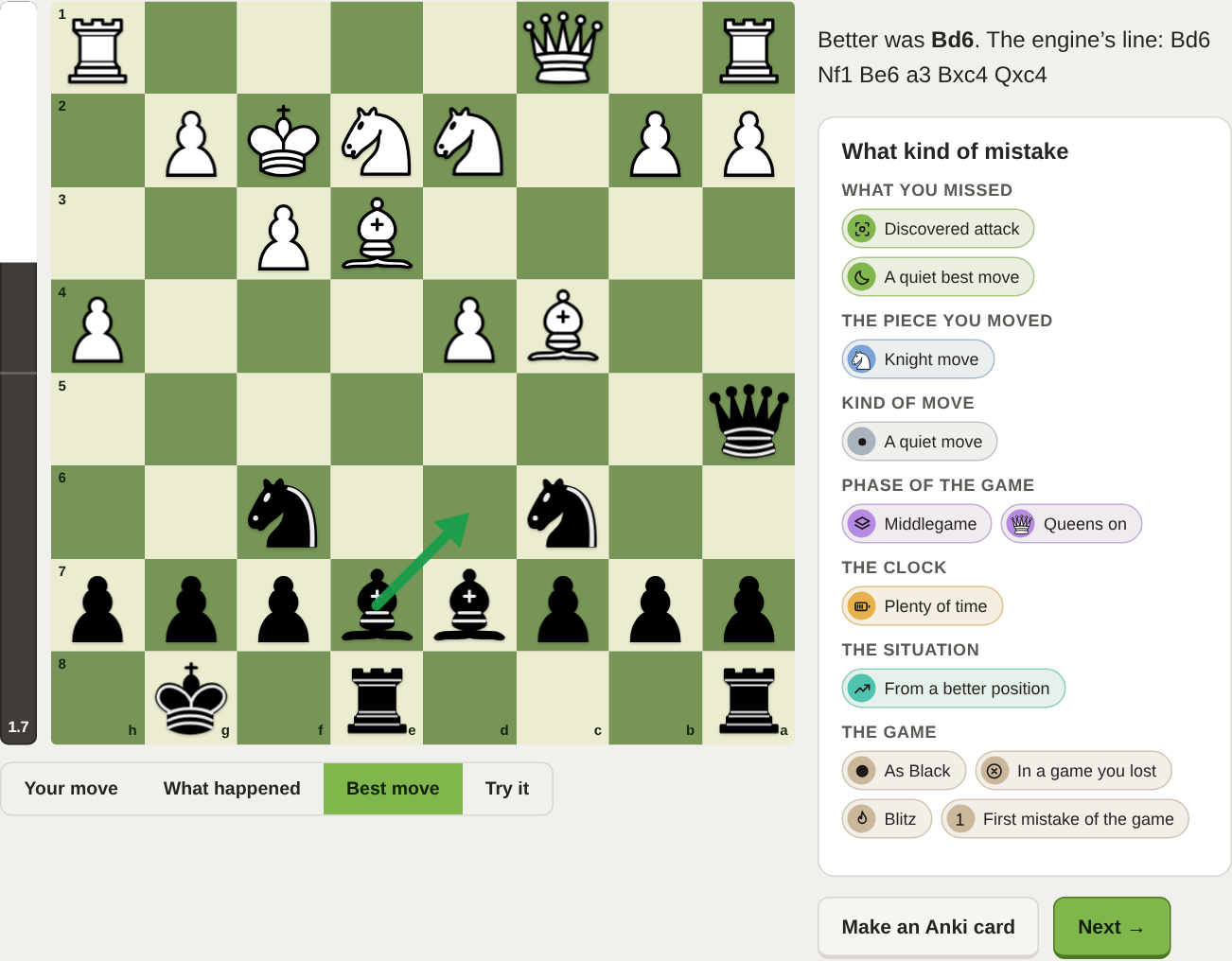
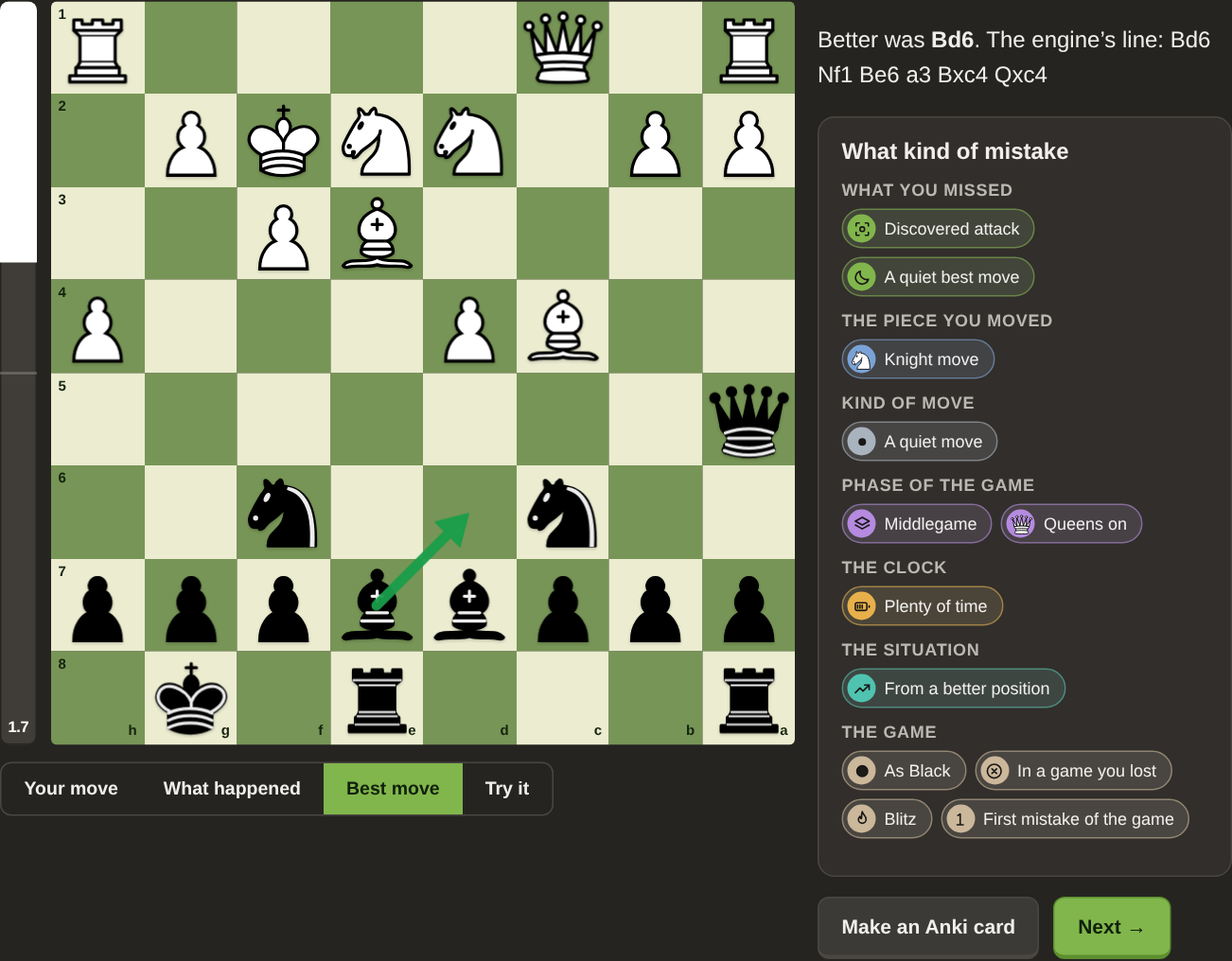
One of my mistakes. The green arrow is the move I should have played. The labels on the right say what went wrong and in what situation. “Try it” lets me play the better move myself.The labels, with how often each shows up in my games. Greyed-out tiles never happened. Each tile opens the positions behind it.
Everything runs in the browser. Only my username leaves the computer.
## My first ranking was wrong
My first version just counted labels. The top of the list looked sensible: “ignored a threat” second, “needed a defence” third. And about 70% of my mistakes came with plenty of time on the clock.
That last number should have warned me. Most of my moves come with plenty of time, so most of my mistakes would too. Counting how often a label appears among my mistakes mixes two things: how weak I am at something, and how often it comes up.
The fix is to count **chances**. For every move I played, the app asks what the engine's best move offered, a fork, a free piece, a defence, and whether I took it. A blind spot is then a pattern I fail far more often than I slip on an ordinary move, which for me is 6% of moves. Three of my first top six disappeared. “Ignored a threat” became 17 failures in 467 real threats: 4%, below my normal. Plenty of time: 6%, the same as every other moment.
## What my games say
*Measured on my last hundred games, mostly fast blitz, played over about six weeks.*
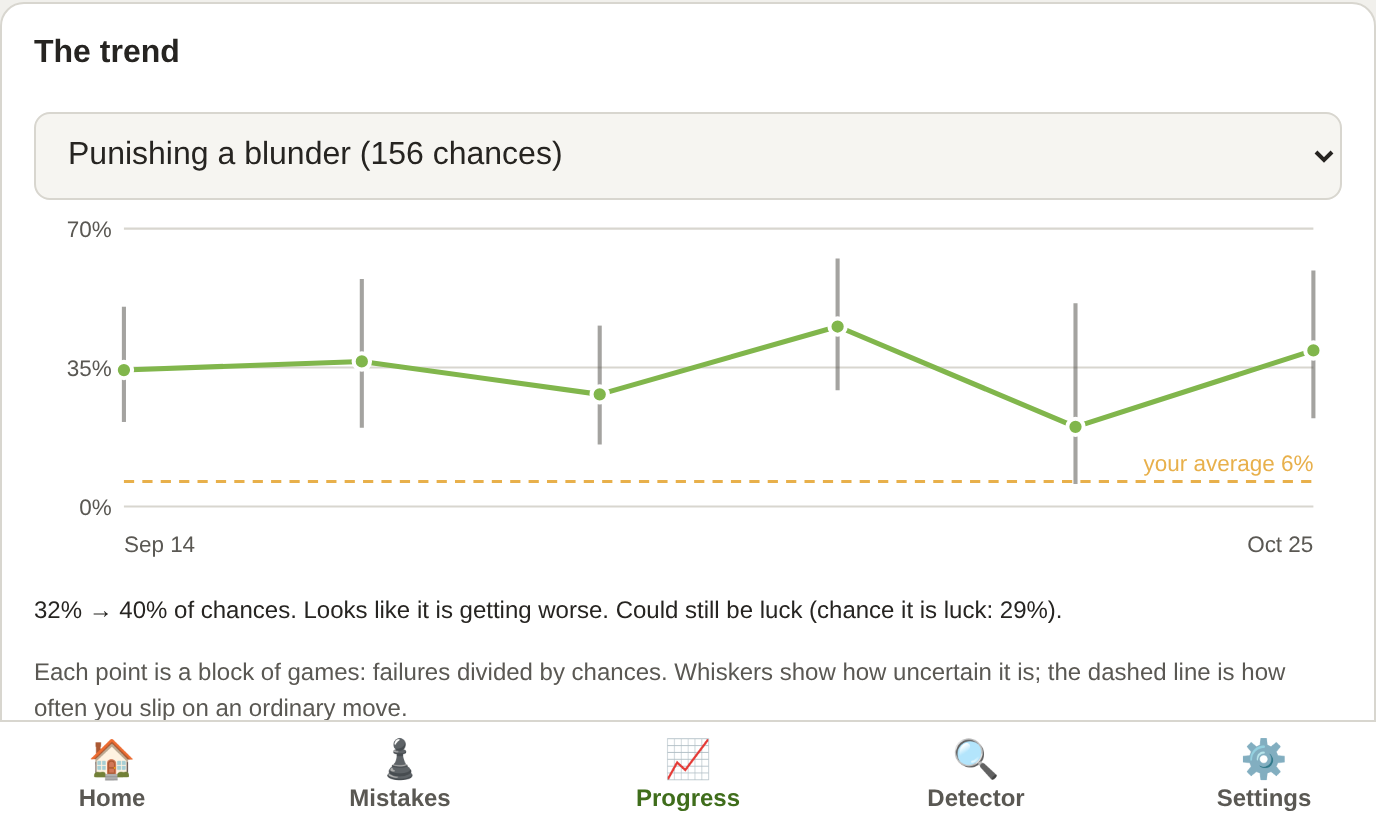
**I do not punish my opponent's mistakes.** After my opponent blundered, I failed to take advantage in 55 of 156 chances: 35%, more than five times my normal rate. Part of that is that I am usually better in those positions, and I slip more when I am ahead. Allowing for that, it is still roughly three times.
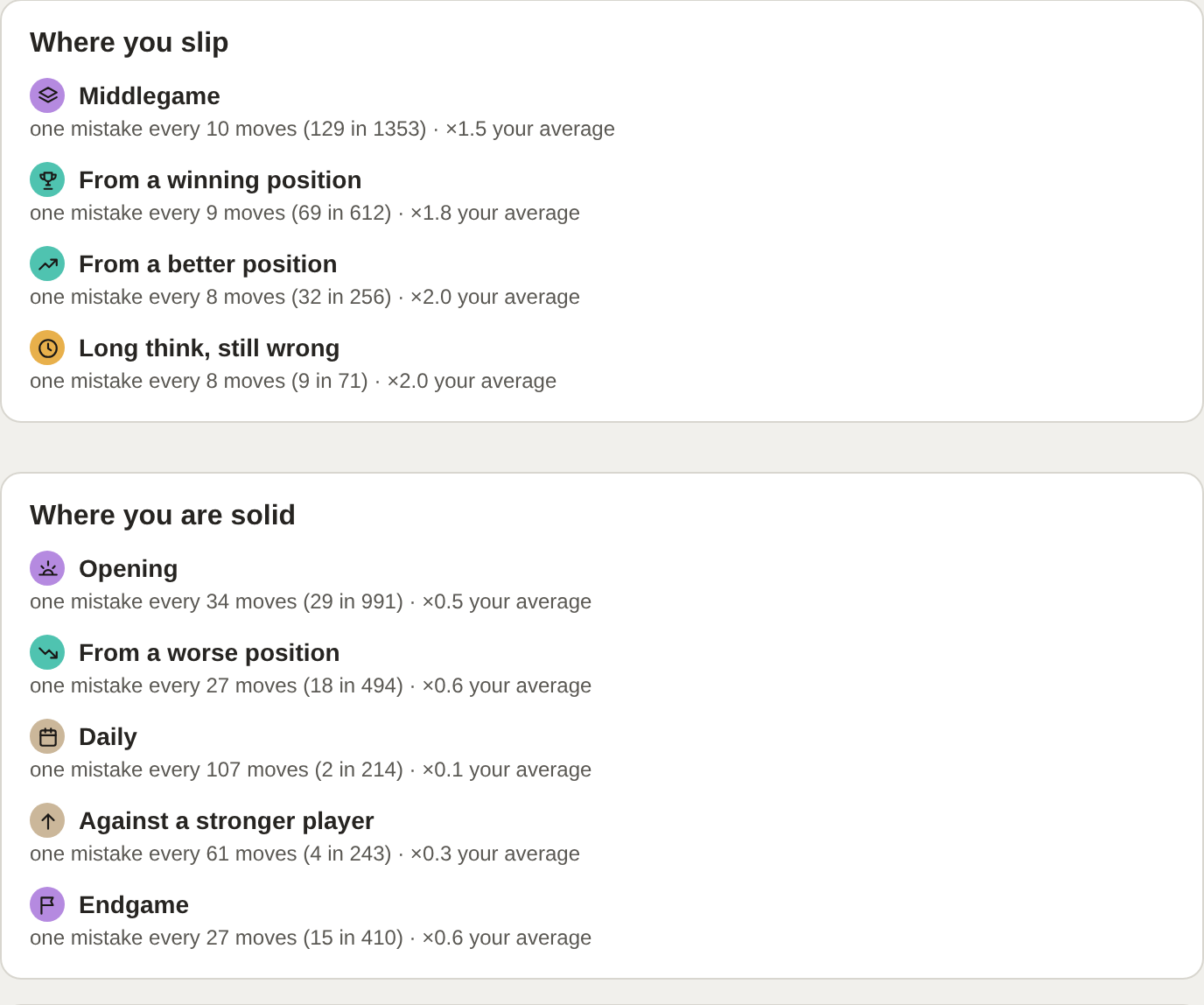
**I slip when I am winning.** From a winning position I make a mistake every nine moves, against one every sixteen overall. I am steadier when I am worse. I am also solid in openings, in endgames and against stronger opponents.
**A few specific misses.** Discovered attacks (15 of 75 chances), trapping a piece (10 of 65), knight forks (8 of 52).
Left: where I slip. Right: where I am solid. “One mistake every N moves” is set against my average, one in sixteen.
My guess, and it is only a guess: when my opponent blunders, or when I get ahead, I relax and stop looking for the next idea. The test to run is to slow down in exactly those moments and see whether the numbers move.
## Mistakes become cards
The app can turn my own mistakes into Anki cards. The card shows the position before the mistake, and I have to find the move I missed. Each card carries the label of its pattern, so I can study one pattern at a time, such as only the knight forks.
Not every mistake makes a good card. My first deck had a card where I was a rook down and the “best” move was a knight sacrifice that only just held the balance, after a long forced sequence. Probably correct, and useless to learn from. Now every candidate gets a second, deeper look. It is dropped if several moves are nearly as good, if the best move only shows up after long calculation, or if the win depends on a long forcing line. I checked 77 candidates, dropped 14, and the deck has 60 cards.
## A way to check a move before I play it
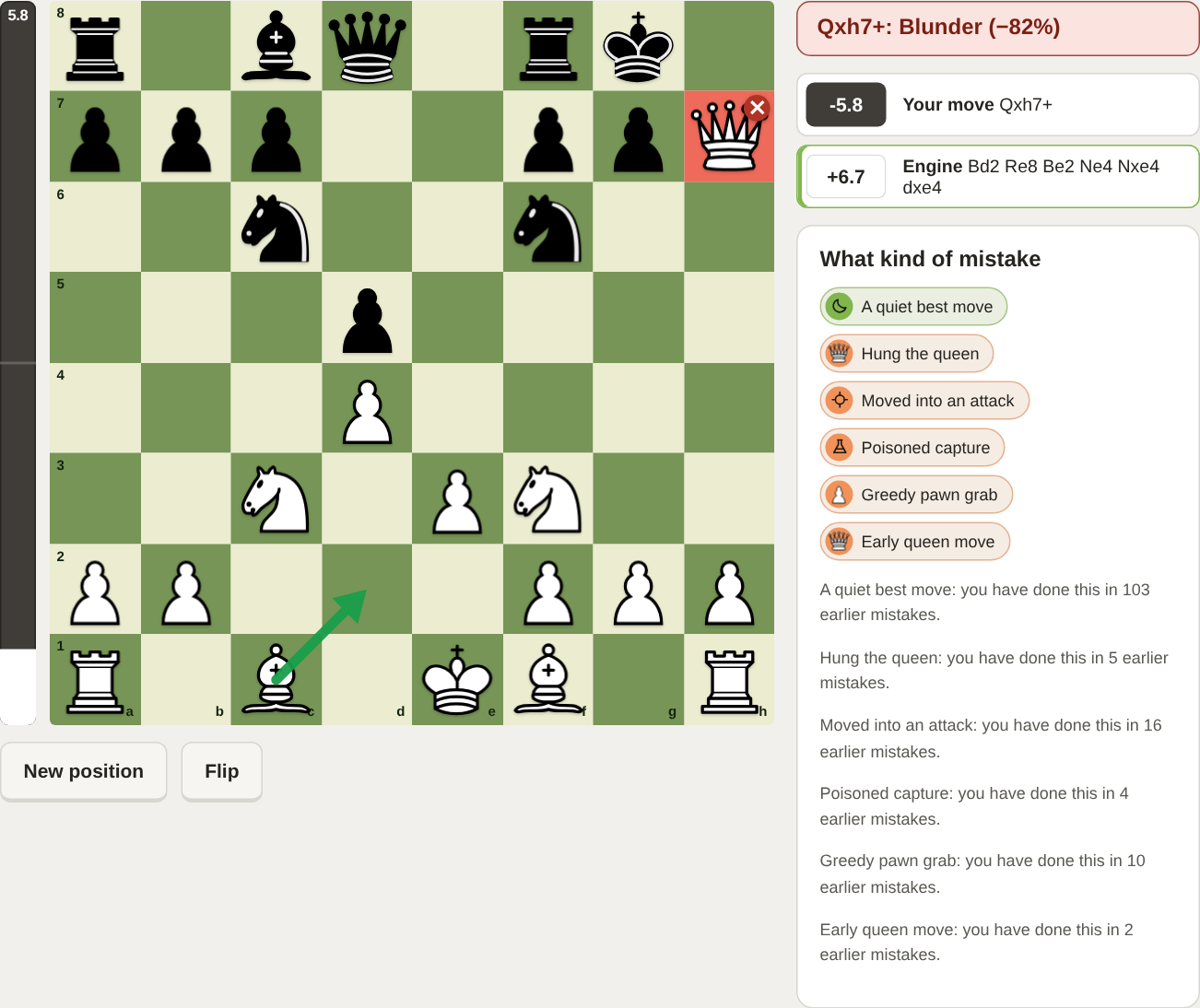
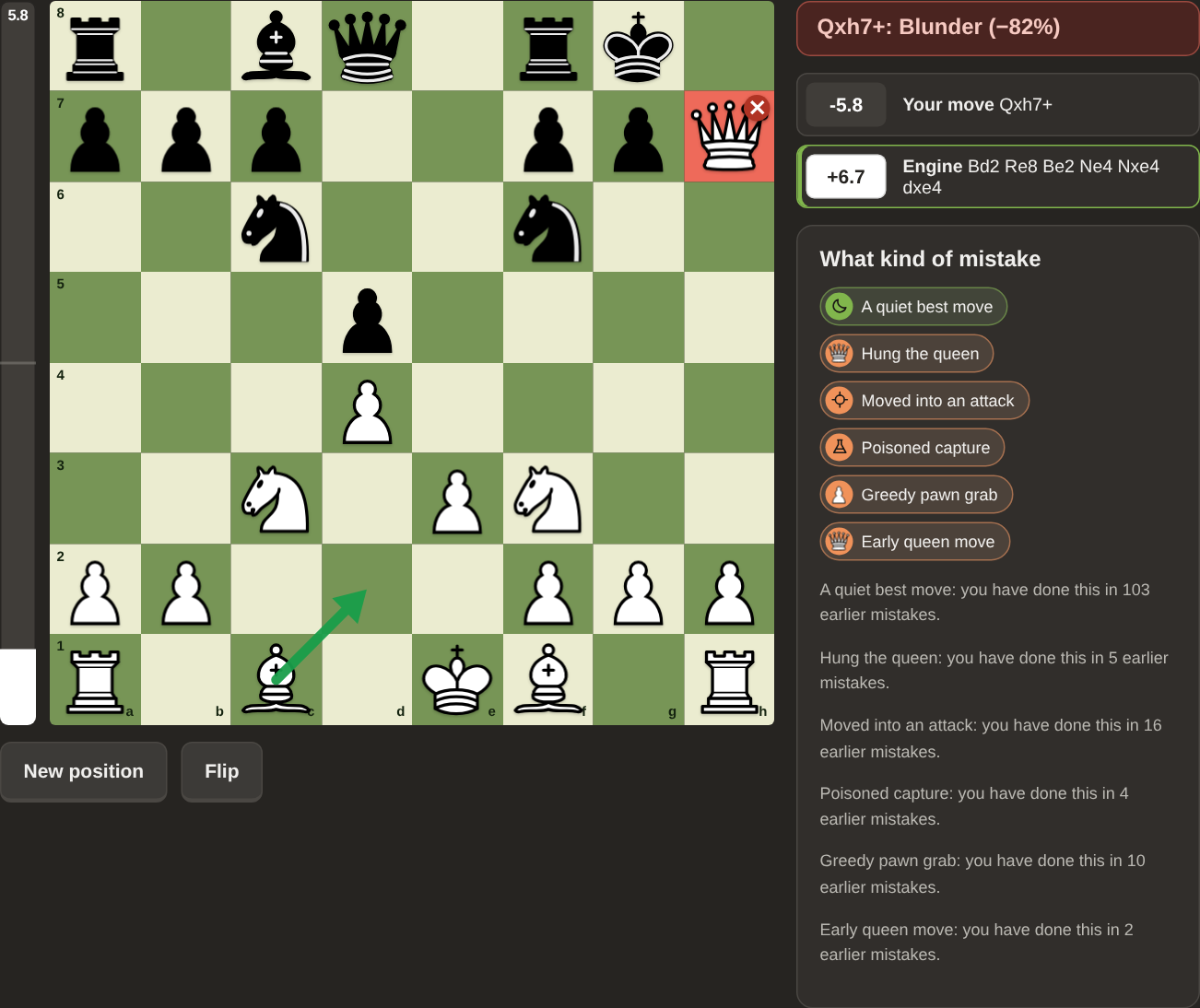
The third piece is a detector. I set up any position and make a move. Stockfish tells me at once whether the move was the best, fine, or a blunder, what kind of mistake it was, and how often I have made that kind before.
I took a defended pawn with my queen. The bar on the left drops, the verdict is “Blunder”, and the labels say what kind it was and how many of my earlier mistakes were the same kind.
This is for study. Using an engine during a live game is cheating, and I do not do it.
## Is it working?
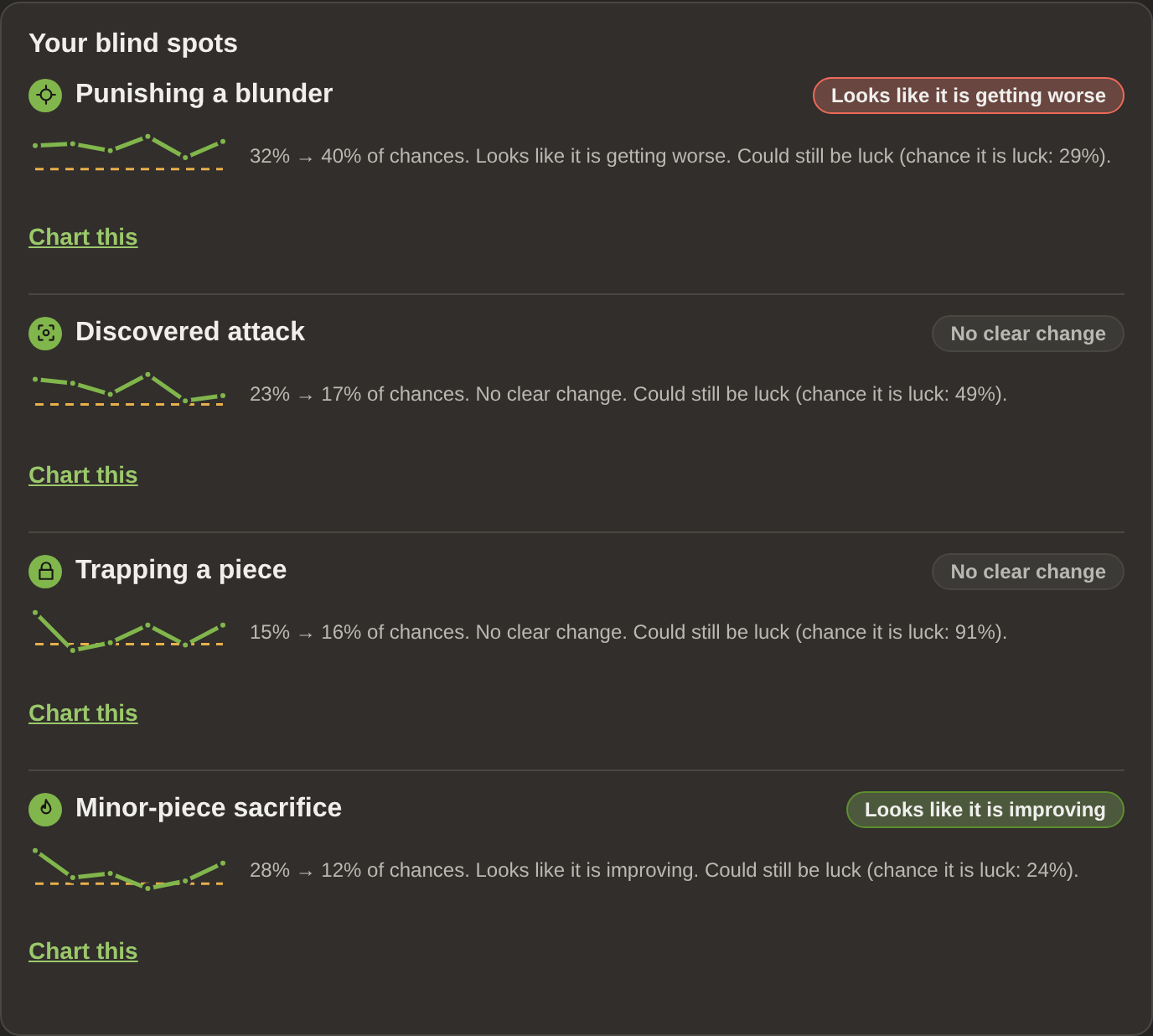
This is the question that matters. For each blind spot, the app compares my older games with my recent ones and says how likely the difference is to be luck. It is cautious on purpose: it says “getting better” only when luck is unlikely.
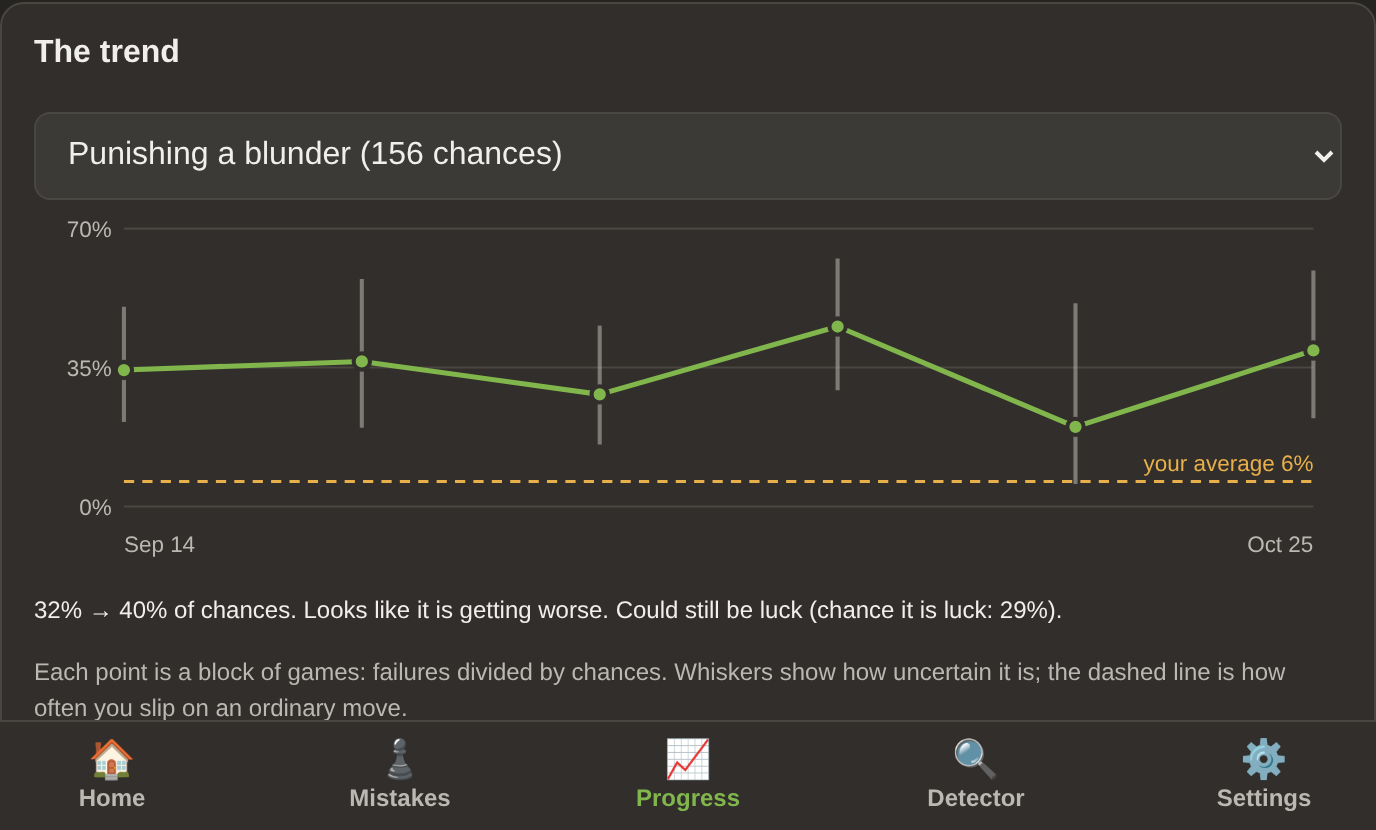
Each blind spot, early against recent. Next to every verdict is the chance that the difference is just luck.One blind spot over time. Each dot is a block of games and the grey whisker is how uncertain it is. The dashed line is how often I slip on an ordinary move.
The honest answer is not yet. My mistakes went from 7% to 6% of moves, but there is a 22% chance that is luck. Blunders did not move. The cards are a day old, so what I have is a starting line, not a result. I have set the day I began studying them. In a few weeks there will be games on both sides of that date, and a fair comparison.
## What this cannot tell me
- It is one player, one hundred games, mostly blitz. Another hundred could rank things differently.
- The labels are the program's best reading of the board, not a verdict. Some are wrong, and I have not yet measured how often.
- A mistake here is a move that gives up a fifth or more of my winning chances, by the engine's judgement. A different cut-off would give different counts.
- Even a clear improvement would not prove the cards caused it.
- I have only used the cards on my computer. The phone version is untested.
So why do I lose half my games? Not for lack of seeing danger. The data point at two habits: not cashing in when my opponent errs, and loosening up once I am ahead. Both can be practised, and now I can tell whether they are changing.